
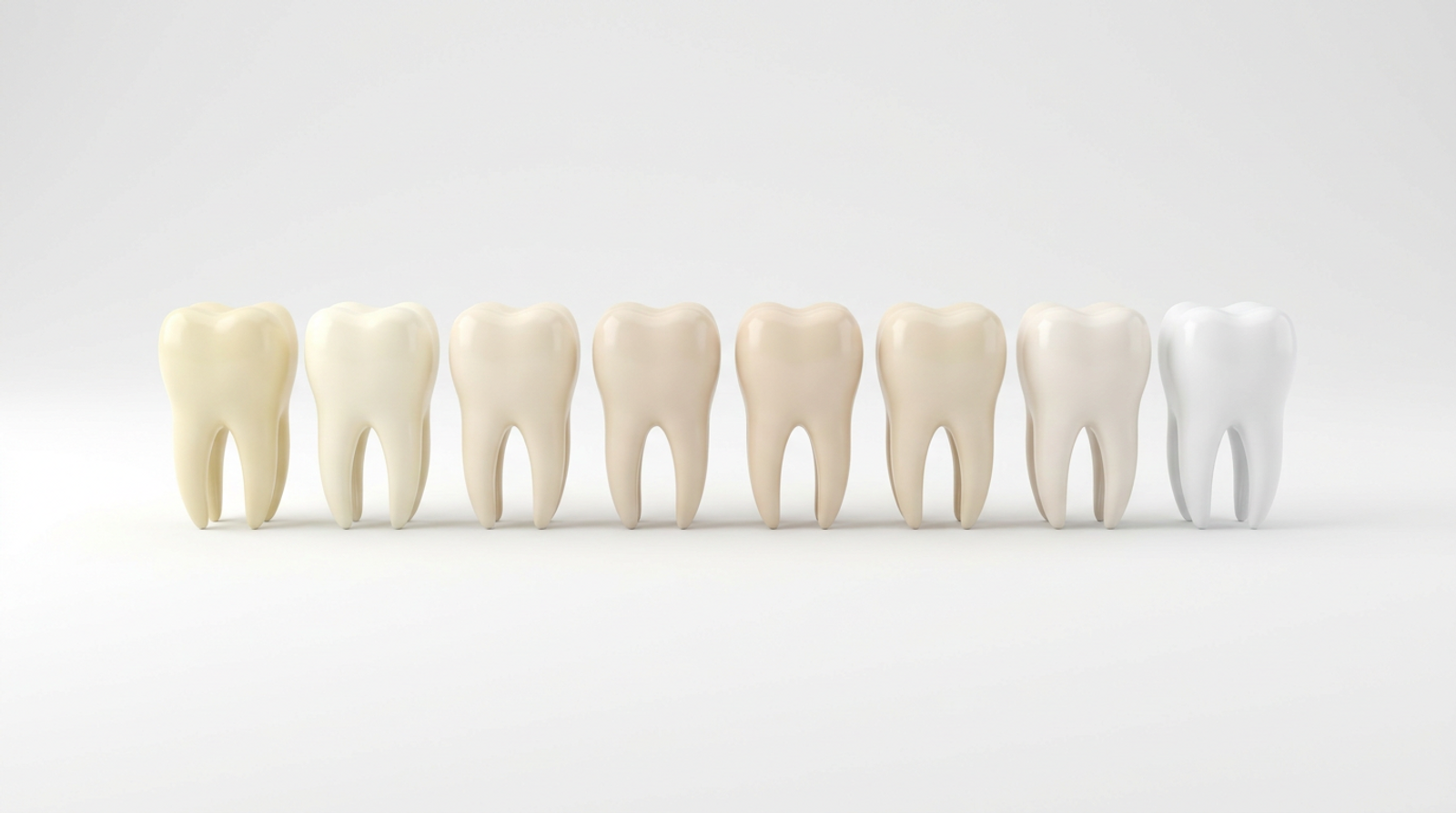
This teeth whitening glossary explains in plain language the terms you may come across at your examination and in your treatment plan. You can find 57 terms on whitening gels, tooth structure, types of discolouration, scale and polish and related cosmetic treatments, grouped alphabetically, and follow links to the relevant pages for more detail. The definitions are for general information.
A–C
- Abrasion
- Wear of the tooth surface caused by mechanical action such as hard brushing, abrasive powders or habits. Frequent use of baking soda can also cause abrasion; details are on our page baking soda and activated charcoal.
- Air polishing
- Cleaning stains and plaque from the tooth surface by spraying air, water and a fine powder under pressure. It can be used after a scale and polish to remove stains.
- At-home whitening
- Whitening done at home with a custom tray and gel supplied by the dentist. It usually takes 1–3 weeks; details are on our page at-home teeth whitening.
- Bonding
- Correcting chips, gaps or irregular shapes by bonding tooth-coloured composite resin to the tooth. It is usually done in a single session and requires little loss of tooth tissue.
- Botox (botulinum toxin)
- A medicine that temporarily relaxes muscles. In dentistry, following assessment by a dentist, it can be used for a gummy smile related to lip movement and on the chewing muscles in teeth clenching; its effect is temporary.
- Bruxism
- Involuntary clenching or grinding of the teeth; it can occur during sleep or during the day. It can lead to tooth wear, jaw pain and headaches. Details are on our page bruxism treatment.
- Carbamide peroxide
- A substance often used in at-home whitening that releases hydrogen peroxide equal to about one third of its weight. Because it acts more slowly, it is suited to longer applications.
- Combined whitening
- An in-office session at the clinic followed by at-home treatment. Details are on our page combined teeth whitening.
- Composite filling
- A tooth-coloured, resin-based filling material. Its colour does not change with whitening, so fillings on the front teeth are usually replaced after whitening.
- Crown
- A restoration that covers the whole tooth; also commonly called a cap. It is made from materials such as porcelain, zirconia or glass ceramic and is not affected by whitening.
D–F
- Dehydration
- The temporary loss of water from the teeth during whitening. Because of this, teeth may look whiter and more matt than they really are at the end of the session; they rehydrate within a few days.
- Dentine
- The yellowish tissue beneath the enamel that makes up most of the tooth. Dentine largely determines the overall colour of the tooth; whitening gel passes through the enamel and also acts on the colour molecules in this layer.
- Desensitiser
- The general name for products used to reduce tooth sensitivity. Gels, toothpastes and varnishes containing potassium nitrate or fluoride can be applied before or after whitening.
- Digital shade measurement (spectrophotometer)
- A method of determining tooth colour numerically with a device that measures light. It reduces differences caused by the eye and ambient lighting, and can be used to compare before and after whitening.
- Enamel
- The outermost layer of the tooth and the hardest tissue in the body. Because it is semi-translucent, the colour of the dentine underneath shows through the enamel.
- Erosion
- The chemical dissolving of enamel caused by acidic drinks, fruit juices or stomach acid. Eroded teeth may look more yellow and be more sensitive; this needs to be assessed before whitening.
- Extrinsic discolouration
- External stains left on the tooth surface by tea, coffee, smoking and coloured foods. They often lessen with a scale and polish; details are on our page smoking, tea and coffee stains.
- Fluoride
- A mineral that makes enamel more resistant to acids. It is found in toothpastes, mouthwashes and in gels and varnishes applied at the clinic.
- Fluoride varnish
- A protective high-fluoride coating painted onto the tooth surface. It helps strengthen enamel and reduce sensitivity.
- Fluorosis
- White, and sometimes brown, spots on the enamel caused by excess fluoride intake while the teeth were developing. Mild forms can be improved with resin infiltration, microabrasion or whitening.
G–I
- Gingival barrier
- A light-cured protective material applied to shield the gums from the gel during in-office whitening. It is easily removed at the end of the session.
- Gingivitis
- Inflammation of the gums caused by plaque and tartar; it causes redness, swelling and bleeding when brushing. It is reversible if treated early.
- Gum recession
- When the gum pulls back and exposes the root surface. An exposed root surface is more prone to sensitivity and is not affected by whitening gel.
- Gummy smile
- When the upper gums show noticeably too much on smiling. Depending on the cause, it can be corrected with methods such as gum contouring, botulinum toxin or orthodontics.
- Hue and value
- Hue describes the colour itself (yellow, reddish, grey); value describes how light or dark the colour is. Whitening mainly increases value, making teeth look lighter.
- Hydrogen peroxide
- The main substance responsible for the effect in teeth whitening. Products containing more than 0.1% and up to 6% are sold only to dentists; details are on our page hydrogen peroxide and carbamide peroxide.
- In-office whitening
- Whitening carried out at the clinic with a higher-concentration gel after the gums have been protected. A session takes about 45–90 minutes; details are on our page light-activated teeth whitening.
- Internal whitening
- Whitening a single root-canal-treated, discoloured tooth by placing gel inside the tooth. Details are on our page whitening a root-canal-treated tooth.
- Intrinsic discolouration
- A colour change originating in the internal structure of the tooth. It can be caused by age, medicines, fluorosis or trauma; it does not go with surface cleaning, and whitening or restorative treatment may be needed.
L–P
- Laser whitening
- The name given to in-office whitening in which the gel is activated with laser light; in Türkiye it is also used for light-activated treatments. Details are on our page laser teeth whitening.
- Light activation
- Activating the gel with blue-violet LED light during in-office whitening. The effect comes mainly from the gel; the additional contribution of the light is debated in scientific studies.
- Microabrasion
- Removing a very thin layer from the enamel surface with a paste containing acid and a fine abrasive. It is used for superficial stains.
- Night guard
- A custom-made hard splint (occlusal splint) that protects the teeth against wear in clenching and grinding. It is different from a whitening tray; it is thicker and more durable.
- Oxidation
- The process in which oxygen released from peroxide breaks large colour-causing molecules into smaller, lighter-coloured fragments. It is the basic chemical mechanism of whitening.
- Pellicle
- A thin protein layer that forms on the tooth surface minutes after brushing. Coloured substances cling to this layer, contributing to surface stains.
- Periodontitis
- Advanced gum disease that affects not only the gums but also the bone holding the tooth. If untreated it can cause teeth to become loose; it must be treated before whitening.
- Plaque
- A soft, sticky layer of bacteria that builds up on the tooth surface. It is removed by brushing and flossing; if not removed, it hardens into tartar.
- Polishing
- Polishing the tooth surface after a scale. A smooth surface reduces how easily plaque and stains reattach.
- Porcelain veneers
- Thin porcelain shells bonded only to the front surface of the tooth. They can be an option for colours that do not lighten with whitening; details are on our page porcelain veneers.
- Potassium nitrate
- A substance that reduces the tooth nerve's sensitivity to stimuli. It is found in desensitising toothpastes and gels.
- Pulp
- The living tissue at the centre of the tooth containing nerves and blood vessels. Sensitivity after whitening is linked to temporary stimulation of the pulp.
R–S
- Rebound effect
- The slight return of the shade in the days after whitening, as the teeth rehydrate. For this reason the true result is usually assessed after 1–2 weeks.
- Remineralisation
- Restoring calcium, phosphate and fluoride to the enamel surface. Saliva and fluoride products support this process.
- Resin infiltration (ICON treatment)
- Drawing a very flowable resin into white spot lesions and hardening it with light. It is popularly known as ICON treatment; no tooth tissue is drilled away.
- Root planing (curettage)
- Removing tartar and inflamed tissue from inside the gum pocket. It is usually done under local anaesthetic as part of the treatment of gum disease.
- Scaling
- Removing tartar from the tooth surface with special instruments; commonly called a scale and polish. Details are on our page scale and polish.
- Shade guide
- A guide made of sample teeth in different shades, used to determine tooth colour. It is used to compare the shade before and after whitening; details are on our page how many shades lighter.
T–Z
- Tartar (calculus)
- A deposit formed when plaque hardens with minerals from saliva. It cannot be removed by brushing and is cleaned at the clinic; details are on our page what is tartar.
- Tetracycline staining
- Grey, brown or banded discolouration caused by tetracycline-group antibiotics taken while the teeth were developing. It responds slowly and to a limited degree to whitening; options such as veneers may also be considered.
- Tooth sensitivity
- A short, sharp twinge triggered by cold, heat or touch. Sensitivity after whitening usually passes within 24–72 hours; details are on our page sensitivity after whitening.
- Translucency
- The tooth's property of partly letting light through. Excessive whitening can make this more pronounced, causing teeth to look grey or see-through.
- Ultrasonic scaler
- An instrument that breaks up and removes tartar using vibration and a water spray. Used correctly, it does not wear away enamel.
- Vital whitening
- Whitening living teeth, that is, teeth that have not had root canal treatment, from the outer surface. In-office, at-home and combined methods fall into this group.
- White diet
- A diet in which dark-coloured food and drinks are avoided for the first 48 hours after whitening. A practical rule: if it would stain a white shirt, do not have it during this period. Details are on our page after whitening.
- White spot lesion
- An area beneath the enamel surface where minerals have been lost, which looks chalky white. It is often seen after braces or as early decay; treatment options are on our page white spot treatment.
- Whitening tray
- A thin, clear, custom-made tray made from impressions so that the gel makes even contact with the teeth during at-home whitening. Ready-made trays may not fit the mouth properly and can let the gel spill onto the gums.
- Zirconia
- A durable, tooth-coloured ceramic restorative material. It is used in crowns and bridges; its colour does not change with whitening.
Frequently asked questions
What is the difference between hydrogen peroxide and carbamide peroxide?
Carbamide peroxide releases hydrogen peroxide equal to about one third of its weight and acts more slowly. For this reason it is mostly used in at-home whitening, while hydrogen peroxide is used at the clinic.
Are scaling and root planing (curettage) the same thing?
No. Scaling is the removal of tartar from the tooth surface; root planing (curettage) is the removal of tartar and inflamed tissue from inside the gum pocket and is carried out for gum disease.
Does the rebound effect mean whitening has failed?
No. Rebound is the slight return of the shade as teeth that lost water during the session rehydrate, and it is expected. The true result is usually assessed after 1–2 weeks.
How are extrinsic and intrinsic discolouration told apart?
Extrinsic stains are on the tooth surface and often lessen with a scale and polish. Intrinsic discolouration is inside the tooth; whitening or restorative treatment may be needed. The dentist makes the distinction at the examination.
Related pages
 Common Misconceptions About Teeth WhiteningDoes it thin enamel, is it permanent, does baking soda work? We explain teeth whitening myths and facts in plain language.
 Hydrogen Peroxide and Carbamide Peroxide: How Does Whitening Gel Work?The active ingredients in whitening gels, how oxidation lightens colour, concentrations and legal limits.
 Teeth Whitening Methods: Which One Suits You?Compare in-office, at-home, combined and internal whitening, pharmacy products and scale and polish side by side using the same criteria.What Is Tartar? How It Differs from Plaque, Signs and PreventionFind out how tartar forms, what signs it causes and why it affects your gum health.
 Teeth Whitening: Frequently Asked QuestionsShort answers to the most common questions about whitening and tartar removal, grouped by topic.
Suitability is decided at an examination. Fill in the form or call us to book an appointment.
Last updated: 2026-11-03 · This page is for general information only and does not replace an examination or diagnosis.