
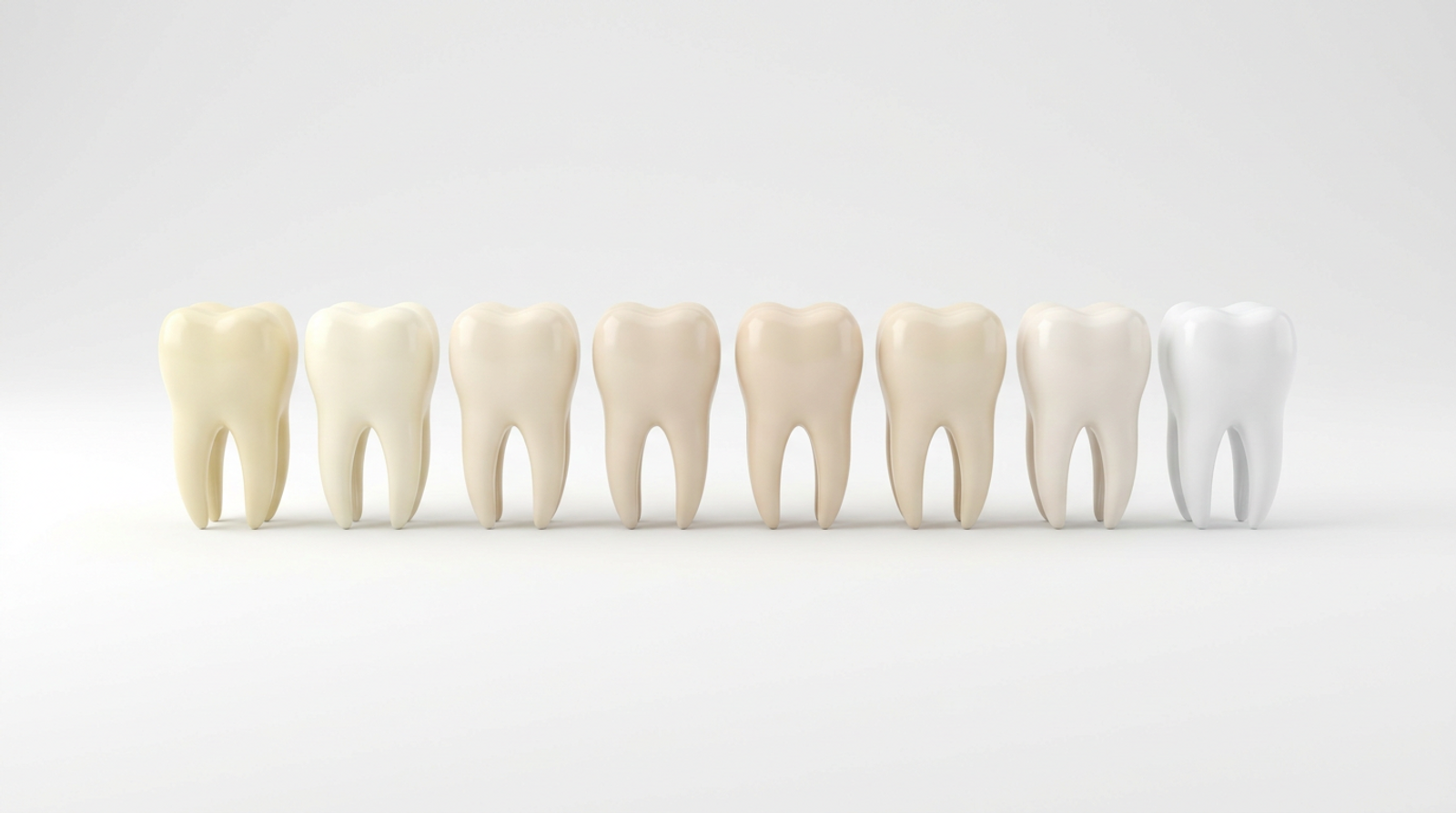
How many shades lighter whitening makes your teeth varies from person to person, and no exact number can be given in advance. On a shade guide arranged by brightness, most people see a lightening of a few steps. Yellowish teeth usually respond better; grey or medication-related discolouration lightens more modestly. The real result is assessed about 1–2 weeks later, once the colour has settled.
How many shades lighter does teeth whitening go?
The honest answer to how many shades lighter whitening makes your teeth is "it depends on your teeth". Even with the same method, the same gel and the same time, two people's results can differ. So firm promises such as "this many shades in one session" are not realistic.
At the examination your starting shade is measured, the cause of the discolouration is assessed and a realistic range of expectations is explained to you. Once the colour has settled, the result is measured with the same guide and compared.
How is a shade guide read?
The classic shade guide commonly used by dentists consists of 16 shade tabs divided into four main groups. The letter indicates the hue and the number the degree of darkness; the higher the number, the darker the shade.
| Group | Hue | Examples |
|---|---|---|
| A | Reddish-brown | A1, A2, A3, A3.5, A4 |
| B | Reddish-yellow | B1, B2, B3, B4 |
| C | Greyish | C1, C2, C3, C4 |
| D | Reddish-grey | D2, D3, D4 |
To assess whitening results, these tabs are usually arranged in a single order from light to dark, that is, by brightness. In this order B1 is among the lightest and C4 among the darkest. When people talk about "shades lighter", they usually mean the number of steps along this order. Some guides also include extra, lighter tabs for bleached teeth.

Are hue and brightness the same thing?
No. Tooth colour is described by three properties, and whitening mainly changes brightness.
- Hue: The type of colour – yellow, reddish or greyish
- Saturation (chroma): The intensity of the colour, such as how deep a yellow it is
- Brightness (value): How light or dark the tooth looks
Our eyes notice differences in brightness more easily than differences in hue. So a tooth that has become less yellow and brighter can look noticeably whiter even if it has not moved many steps on the guide. Dentists measure with both the shade guide and photographs.
Realistic expectations
Scientific studies of in-office or take-home whitening carried out for an appropriate time often report a change of a few steps on a guide arranged by brightness. This change varies widely from person to person.
| Starting point | General expectation |
|---|---|
| Yellow or light brown shades | Usually noticeable lightening |
| Age-related darkening | Often responds well; may take longer |
| Tea, coffee and tobacco stains | Surface stains lift with cleaning, internal colour with whitening |
| Grey shades | More limited and slower lightening |
| Medication-related banded discolouration | May remain limited even with prolonged treatment |
| A single dark root-filled tooth | Assessed for internal whitening |
For stubborn discolouration, combined whitening may give a better result. For a single dark tooth, see our whitening a root-filled tooth page.
How is shade measured accurately?
For an accurate comparison, the measurement should be taken under similar conditions every time. The same tooth, the same shade guide and similar lighting are used.
- The shade is measured before treatment, before the teeth dry out.
- Neutral lighting close to daylight is preferred.
- Surrounding colours, such as lipstick or brightly coloured clothing, can affect the assessment.
- As well as the shade guide, the measurement is recorded in photographs.
- The final assessment is made under the same conditions once the colour has settled.
Visual shade assessment can vary slightly between observers. So a photographic record makes it easier to compare before and after.
What does the change in shade depend on?
The change in shade is determined mainly by the type of discolouration and the structure of the tooth. The method used and the treatment time also affect the result.
- Starting shade: A tooth that is already very light has less room to lighten.
- Cause of discolouration: External stains and colour within the tooth's internal structure respond differently.
- Age: With age, dentine darkens and enamel thins.
- Enamel thickness: Thin enamel lets more of the underlying dentine colour show through.
- Method and time: How long the gel is in contact with the tooth directly affects the result.
- Sensitivity: If treatment has to be shortened because of sensitivity, lightening may be limited.
- Habits: Smoking, tea and coffee during treatment slow down the result.
For the causes of discolouration, see our tooth yellowing and stains page.
Dehydration and rebound: why does the colour come back a little?
Straight after whitening, teeth look whiter than they really are because they lose water during treatment. Dehydrated enamel reflects light differently and looks more opaque and whiter. This is called dehydration.
As the tooth regains moisture over a few days, the colour comes back somewhat. This natural process is called the rebound effect and does not mean treatment has failed. The true shade usually settles within 1–2 weeks. That is why the result is assessed, and any filling shade chosen, after this time.
The shade measured at the end of the session may differ from the shade two weeks later. Always compare against the settled shade.
Is whiter always better?
No. Every tooth has a limit to how light it can go, and continuing treatment beyond that point brings no extra benefit. On the contrary, it can increase sensitivity and gum irritation.
Over-whitened teeth can sometimes take on a grey or translucent look; this can be more noticeable at the biting edges. The goal is a whiteness that suits your face and the natural structure of your teeth. Dental supervision is important to judge this limit.

Why do results vary from person to person?
Because every tooth differs in structure, colour and history. Even two people from the same family can differ in enamel thickness, dentine colour and habits. So someone else's result is not a yardstick for yours.
One more point to remember: fillings, crowns and veneers do not whiten. If you have such restorations on your front teeth, a colour mismatch may appear after whitening. You can find what to expect before and after the session on our whitening session page. Our clinic is in Oran, Çankaya, Ankara; you can book an appointment for shade measurement and an examination.
Frequently asked questions
How many shades lighter does one whitening session make teeth?
No exact number can be given. On a guide arranged by brightness, most people see a lightening of a few steps; the result varies from person to person.
Why did the colour darken a little after whitening?
Teeth lose water during treatment and temporarily look whiter. As they regain moisture, the colour comes back somewhat; the true shade settles within 1–2 weeks.
On a shade guide, is A1 or B1 lighter?
In the brightness order, B1 is generally considered the lightest shade; A1 is very close to it.
Can grey teeth be lightened with whitening?
Grey-toned teeth lighten more modestly and more slowly than yellow-toned teeth. Prolonged or combined treatment can be tried, but the result may remain limited.
What if my teeth do not get as white as I want?
Once the colour has settled, a second session or take-home support can be considered. Where whitening is not enough, your dentist can discuss options such as veneers.
Related pages
 Before and after
 How Many Sessions Does Teeth Whitening Take?The number of sessions for in-office, at-home and combined whitening, how long a session lasts and what the overall process depends on.
 Combined Teeth WhiteningA planned approach that combines the speed of a light-activated session in the clinic with the gradual effect of a custom tray used at home.
 Why Do Teeth Turn Yellow? Tooth Discolouration and Types of StainsTell external and internal discolouration apart; find out which stains lighten with whitening and which need other treatment.
 Do Crowns and Fillings Whiten? Shade Matching in WhiteningWhitening gel only works on natural tooth tissue; the right sequence is needed to match the shade of restorations.
Suitability is decided at an examination. Fill in the form or call us to book an appointment.
Last updated: 2026-11-03 · This page is for general information only and does not replace an examination or diagnosis.