
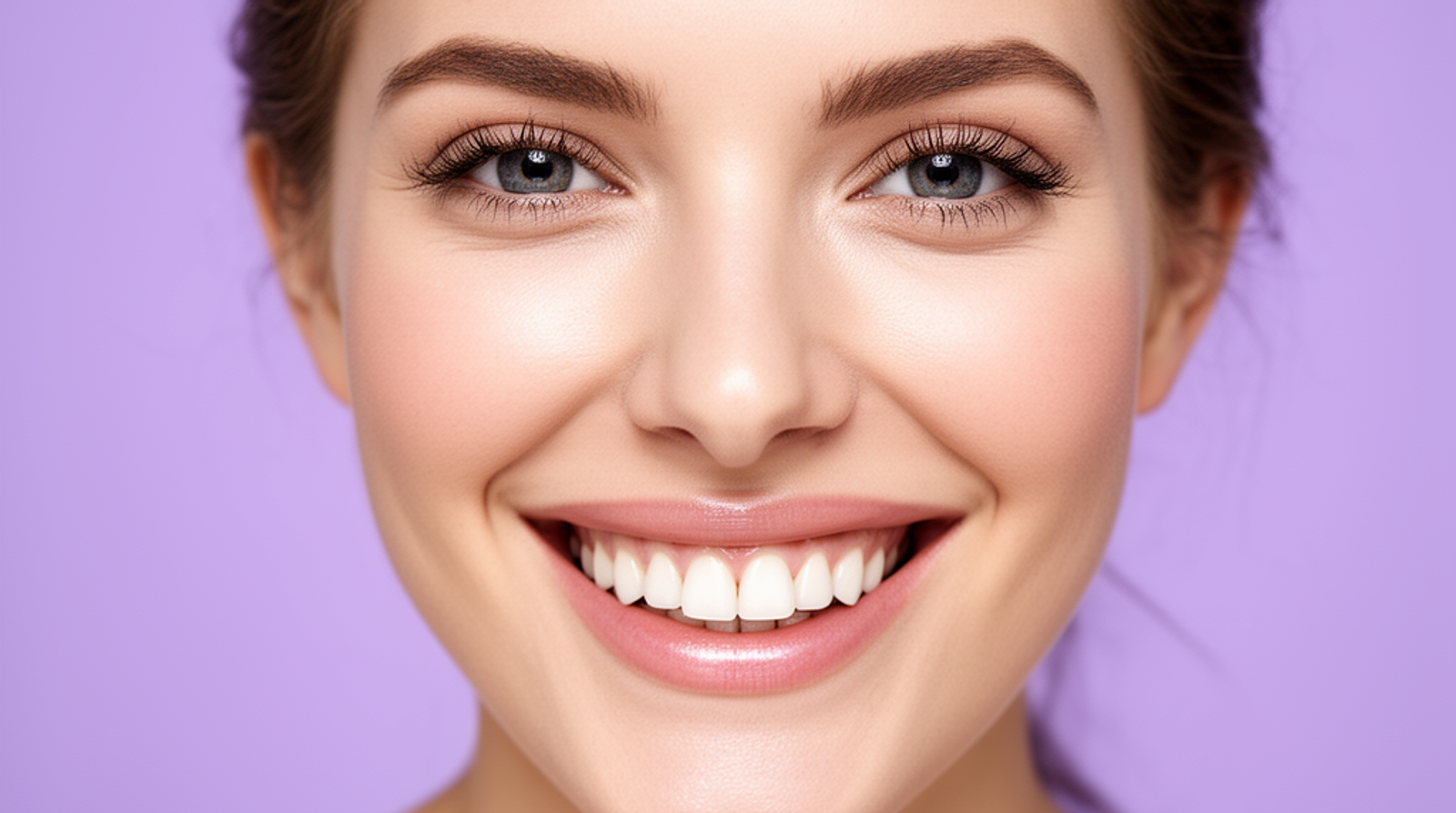
Porcelain veneers are custom porcelain shells about 0.3–0.7 mm thick that cover only the front surface of the tooth. They are used to correct colour, shape, length and small gaps. Treatment is usually completed in 2–3 visits and aims to remove as little healthy tooth tissue as possible. If only the tooth's colour is the issue, whitening is considered; if the shape is also to change, veneers are considered.
What are porcelain veneers?
Porcelain veneers are thin porcelain shells permanently bonded to the front surface of the teeth. They are also known as porcelain laminates.
Veneers can change the colour, shape and length of a tooth. Because porcelain transmits light in a similar way to natural enamel, it gives a natural appearance. As the porcelain surface is smooth, it picks up tea and coffee stains less than a natural tooth.
Veneers are usually made from highly translucent porcelains such as glass ceramic. Each shell is made individually in the laboratory to fit the tooth and the planned smile. They are mostly fitted to the front teeth that show when you smile; how many teeth are treated depends on the width of the smile.

Who are porcelain veneers suitable for?
Porcelain veneers may be suitable for people who want to correct colour and shape problems on the front teeth together. Suitability is decided at the examination, based on the health of the teeth and gums.
- Discolouration that does not lighten with whitening (for example some medication stains)
- Chipped, worn or short front teeth
- Small gaps between teeth
- Mismatched shape and length, mild irregularities
Severe crowding may need orthodontics first. Active gum disease and decay are treated first. If too much gum shows when you smile, the gum line can be corrected with gummy smile treatment before veneers.
Who may they not be suitable for?
For people who do not have enough healthy enamel on their teeth, or who have active gum disease or untreated decay, veneers are not the first choice. In these cases the underlying problem is treated first.
- Teeth with very large fillings or severe fractures (a crown may be more suitable)
- Heavy teeth clenching that is not under control
- Severe crowding or bite problems
- Inadequate oral hygiene
Having one of these conditions may not rule out veneers completely, but the plan changes. For example, clenching can be controlled with a night guard, and veneers can be reconsidered once gum disease has been treated. Sometimes less invasive options such as whitening and bonding are enough to meet expectations.
Veneers or whitening?
If the problem is only colour, whitening is often considered first; if colour, shape and length are all to change, veneers may be more suitable. Whitening lightens the colour without touching tooth tissue, while veneers completely reshape the appearance of the tooth.
| Feature | Teeth whitening | Porcelain veneers |
|---|---|---|
| What does it change? | Only the colour of the natural tooth | Colour, shape, length and small gaps |
| Tooth tissue | Tissue is not touched | Minimal preparation in most cases |
| Process | 1 session or 1–3 weeks take-home | Usually 2–3 visits |
| Longevity | About 1–3 years, can be topped up | Many years; colour does not change |
| Reversibility | You return to your natural tooth | Generally considered irreversible |
If natural teeth next to those receiving veneers also show, whitening is done first and the veneer shade is chosen to match the new colour. For the methods, see our teeth whitening methods page.
What is the difference between veneers and zirconia crowns?
A veneer covers only the front surface of the tooth, while a zirconia crown covers the whole tooth. So less tooth tissue is removed for a veneer.
| Feature | Porcelain veneer | Zirconia crown |
|---|---|---|
| Area covered | Front surface of the tooth | The whole tooth |
| Tooth preparation | Minimal or none | More reduction needed |
| Suitable for | Colour and shape problems on sound teeth | Large fractures, big fillings, root-filled teeth |
| Translucency | High, close to natural enamel | Varies by material |
Which is suitable is decided by the dentist according to the condition of the tooth. Neither changes colour with whitening; details are on our do crowns and fillings whiten page.
How does porcelain veneer treatment proceed?
Porcelain veneers are usually completed in 2–3 visits over a few weeks. The process starts with planning and ends with a check-up.
- Examination, photographs and smile planning
- A trial in the mouth (mock-up) so you can preview the result
- Minimal tooth preparation where needed; in some cases no preparation
- Impressions and, if needed, temporary veneers
- Laboratory fabrication, try-in and bonding
- Check-up appointment
Local anaesthetic may be used for comfort during preparation. There may be mild sensitivity for a few days after bonding. While you get used to your new teeth, speaking and biting may feel slightly different in the first days; this usually passes quickly. At the check-up, the bite and how the gums sit around the veneers are reassessed.

What is the difference between composite and porcelain veneers?
Composite veneers are made by shaping resin directly on the tooth, whereas porcelain veneers are made in a laboratory. Composite is often finished in a single visit and can be repaired; porcelain keeps its colour stability and surface shine for longer. Composite can pick up colour over time and may need periodic polishing. Which material is suitable is discussed at the examination, based on your expectations, tooth structure and habits.
How are veneers looked after and how long do they last?
Veneers need daily care just like natural teeth; with proper care they can last for many years. Sources usually quote ranges such as 10–15 years, but this varies from person to person.
Porcelain does not change colour, but the natural teeth and the cement line at the edges of the veneers can pick up colour over time. That is why regular care is important.
- Brushing twice a day, flossing and interdental brushes
- Not breaking hard objects such as pens, nails or seed shells with your teeth
- Wearing a mouthguard for sport if needed
- A check-up and tartar removal every 6 months
Does teeth clenching affect veneers?
Yes; clenching and grinding can increase the risk of veneers chipping or coming off. In this case veneers are usually planned together with a night guard.
If you notice jaw tiredness in the morning or wear on your teeth, mention it at the examination. For details, see our teeth clenching (bruxism) treatment page.
Frequently asked questions
Are teeth filed down for porcelain veneers?
In most cases only minimal preparation is done; in some cases no preparation is needed at all. This is decided at the examination.
Do porcelain veneers hurt?
Local anaesthetic may be used for comfort during preparation. Mild sensitivity after the procedure usually passes within a few days.
Can veneers be whitened?
No. The colour of porcelain does not change with whitening; if you want a whiter shade, whitening is planned before the veneers.
How many visits do porcelain veneers take?
They are usually completed in 2–3 visits over a few weeks.
Are veneers or zirconia crowns more suitable?
Veneers are considered for colour and shape problems on sound teeth, and zirconia crowns for large fractures, big fillings or root-filled teeth. The decision is made at the examination according to the condition of the tooth.
Can veneers fall off?
With correct bonding and care, they are not expected to come off. Biting hard objects and clenching increase the risk.
Related pages
 Teeth Whitening Methods: Which One Suits You?Compare in-office, at-home, combined and internal whitening, pharmacy products and scale and polish side by side using the same criteria.
 Do Crowns and Fillings Whiten? Shade Matching in WhiteningWhitening gel only works on natural tooth tissue; the right sequence is needed to match the shade of restorations.
 Gummy Smile TreatmentCorrecting excessive gum display when you smile with gum contouring, Botox or other methods, depending on the cause.
 Teeth Clenching and Grinding (Bruxism) TreatmentTreatment options aimed at reducing the damage that clenching and grinding during the night or day cause to the teeth and jaw joint.
 White Spot Treatment (ICON Treatment / Resin Infiltration)Making white spots on the teeth less visible by filling them with a flowable resin, without drilling away tooth tissue.
Suitability is decided at an examination. Fill in the form or call us to book an appointment.
Last updated: 2026-11-03 · This page is for general information only and does not replace an examination or diagnosis.